

The CMI framework is the Content Marketing Institute’s Content Marketing Framework: five building blocks called Purpose and goals, Audience, Story, Process and Measurement. Robert Rose published this version on CMI’s site on October 27, 2016 as the 2017 update of a framework CMI had unveiled three years earlier. For the Measurement block, CMI publishes two models you can use directly: a three-tier content marketing pyramid and a five-stage content measurement framework updated in February 2026.
Below you get each framework in CMI’s own words, what CMI’s 2026 B2B research says about them, and then the part most searchers actually need: a copy-ready content measurement framework with goals, KPIs, GA4 event names, formulas, a maturity checklist and a monthly report template.
The CMI frameworks at a glance
CMI publishes guidance, not a certification standard, so “CMI framework” can point to several models. These are the ones CMI itself has published, with the date and author of each.
| Framework | Published by CMI | What it is for | Use it when |
|---|---|---|---|
| Content Marketing Framework (5 building blocks) | Robert Rose, Oct 27, 2016 (the “2017” version) | Planning a whole content program: why, for whom, what story, how it runs, how it is judged | You are writing or rewriting a documented content strategy |
| Content marketing pyramid (primary, secondary, user indicators) | Joe Pulizzi, June 1, 2013, drawn from the CMI book Managing Content Marketing by Rose and Pulizzi | Deciding which metrics go to the CEO, which to managers, which to the people making content | Leadership asks “is content working?” and you have 40 metrics and no answer |
| 5-stage content measurement framework (See us, Connect with us, Trust us, Choose us, Champion us) | Ann Gynn, Feb 19, 2026 (updated from a 2021 story) | Picking metrics for each stage from awareness to advocacy | You need a metric list per funnel stage, with GA4 and Search Console sources |
| Five-stage maturity scale (Exploratory to Leading) | CMI and MarketingProfs, B2B Content and Marketing Trends: Insights for 2026 | Rating how far along a capability is | You want to benchmark your program against 1,015 B2B marketers |
| Strategy, planning and measurement templates | Jodi Harris roundup, Dec 29, 2016 | Core strategy statement, decision matrix, editorial calendar, KPI tracker, editorial reporting template | You want CMI’s own worksheets behind each building block |
One caution. Some blogs attribute a “4C” model (Connect, Create, Curate, Convert) or a five-stage “content maturity model” with stages like “reactive” and “predictive” to CMI. I found neither on CMI’s own pages. The maturity scale CMI actually uses is the Exploratory, Developing, Established, Advanced, Leading scale in its 2026 research, covered below.
The CMI Content Marketing Framework: 5 building blocks
CMI’s article gives one definition per block. The CMI slide deck for the same framework lists the working parts under each. The last column is the document you should be able to hand someone when the block is done.
| Building block | CMI’s definition | Parts CMI lists in the deck | Done when you have |
|---|---|---|---|
| Purpose and goals | “Why you are creating content and what value it will provide” | Mission questions (business goals, target audience, the valuable content experience, “content tilt”); goal types: campaign, cost-savings, business-growth | A one-paragraph mission and 1 to 3 goals, each with a number and a date |
| Audience | “For whom you are creating content and how they will benefit” | Internal stakeholders, external audience, subscriber levels (Reach, Engage, Inspire) | Named buyer roles, the questions each asks before buying, and the subscriber action you want |
| Story | “What specific, unique, and valuable ideas you will build your content assets around” | The unique idea that turns a subscribed audience into value | A short list of themes your firm can say with more authority than the top-ranking competitors |
| Process | “How you will structure and manage your operations to activate your plans” | Content taxonomy, standard routing (workflow), team skills, style and contributor guidelines, channel plan, tools and systems | A workflow with owners and turnaround times, plus a dated content roadmap |
| Measurement | “How you will gauge performance and continually optimize your efforts” | An analytics pyramid with primary, secondary and user indicators | The measurement template in this article, filled in, with one owner per metric |
CMI’s template roundup adds a shortcut for the first three blocks: a fill-in-the-blank “core strategy” statement by Meghan Casey built on three components, “your business goals, your target audience, and the needs of that audience,” plus her decision matrix that scores each idea 1 to 5 on business benefit and audience value and suggests dropping ideas that score 3 or less (CMI, 15 essential tools and templates). If you want someone to own all five blocks, the job description and rubric in our guide to hiring a content strategist map to them.
CMI’s content marketing pyramid: primary, secondary and user indicators
This is the measurement model behind the fifth building block. Joe Pulizzi described it in a 2013 CMI post (the original URL now redirects to a news listing, so the link is an archived copy). Three tiers, three audiences:
| Tier | Who sees it | CMI’s examples | How often it changes |
|---|---|---|---|
| Primary indicators (top) | Your manager or CXO | Sales, cost savings, retention rates | “Rarely change, if ever.” Very few in number. |
| Secondary indicators (middle) | Team members and process owners | Lead quality, lead quantity, shorter sales cycles | Tracked as “short-term goals” |
| User indicators (base) | The people making content | Web traffic, page views, search rankings, social shares, blog subscriptions | Changed “on a frequent basis” |
CMI’s worked example is useful because it is so narrow. Goal: “increase the number of converted leads by 10 percent without raising costs” using a new instructional blog. The CXO dashboard gets exactly two numbers: converted leads per period and total cost per converted lead. Secondary indicators include email subscribers against goal, total leads, incremental leads from the new blog and lead source. Everything else (visitors, returning visitors, comments, shares, keyword rankings) stays at the base, for the content team. The rule worth copying: build one pyramid per goal, and never show the base tier to the CEO.
CMI’s 2026 content measurement framework: see us to champion us
CMI’s current answer to “content measurement framework” is Ann Gynn’s 5-step content measurement framework, dated February 19, 2026. It organizes metrics into five audience stages and names the metric source for most of them:
- See us (awareness): engaged sessions in GA4, social impressions, video views, Search Console impressions.
- Connect with us (engagement): organic search clicks, social engagement rate calculated against reach rather than follower count, video play rate and view-through rate, scroll depth, downloads.
- Trust us (consideration): followers, email subscribers, returning users, outbound link clicks (GA4’s “click” event filtered by destination), shares, branded search growth, community participation.
- Choose us (conversion): lead form completions, content-assisted conversions, sales page traffic by source, sales cycle length for content-engaged prospects, content found in won deals via the CRM.
- Champion us (retention and advocacy): customer content engagement, expansion revenue influenced by content, case studies and reviews, NPS and retention compared between content-engaged and other customers.
Its stance on attribution is the honest one: “Accept that some impact will be directional rather than precisely measurable.” The template below turns those five stages into the four rows most firms report on, with the event names and formulas filled in.
What CMI’s 2026 B2B research says about strategy and measurement
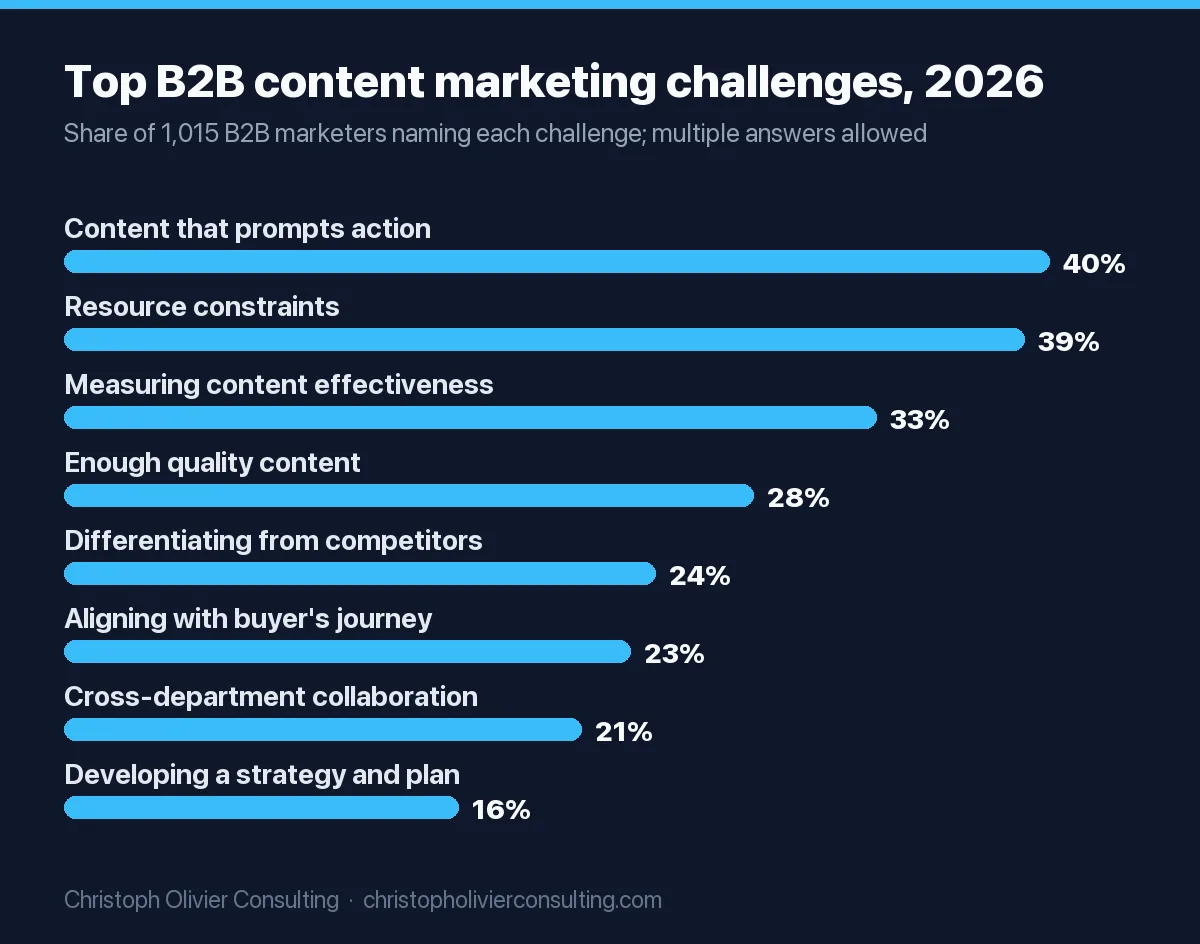
CMI’s annual B2B study was called “B2B Content Marketing Benchmarks, Budgets, and Trends” through the Outlook for 2025 edition. The current edition is B2B Content and Marketing Trends: Insights for 2026, written up by Robert Rose on October 8, 2025. Method: the 16th annual survey by CMI and MarketingProfs, sponsored by Storyblok, fielded June 24 to August 14, 2025, with 1,229 global responses, of which the report covers 1,015 B2B marketers, mostly from North America. Consulting firms were 11% of the sample and professional services 4%.
| Finding | Figure | What it means for your framework |
|---|---|---|
| Have a content strategy | 97% | Having one is no longer the difference |
| Strategy “significantly improved” results | 13% (48% “somewhat improved”) | Most strategies are documented but not working hard |
| Top driver of improvement | Strategy refinement, 74%; new technology, 51%; measurement capabilities, 26% | Revise the five building blocks, do not just buy tools |
| Rate their marketing “highly effective” | 12% (47% “somewhat effective”) | Most teams met most goals; few exceeded them |
| Name measuring content effectiveness as a top challenge | 33% | The Measurement block is the weakest of the five |
| Measure thought leadership by business impact (leads, pipeline influence) | 63% overall, 75% of pacesetters | The more mature teams report pipeline, not just views |
The report also defines the maturity scale it uses across every category: Exploratory (initial implementation, preliminary results being gathered), Developing (basic implementation, mixed early outcomes), Established (consistent implementation with measurable results), Advanced (optimized implementation with strong ROI) and Leading (industry-leading implementation with exceptional measurable outcomes). “Pacesetters” are those at Established or above. The checklist further down scores you on that same scale.
Content measurement framework template: goals, KPIs, metrics, data sources
Copy this into a sheet. It collapses CMI’s five stages into four reporting rows (Trust us merges into Engagement, Champion us becomes Retention) and assigns each row a goal, one KPI for the top of CMI’s pyramid, supporting metrics, the exact GA4 event or report, and an owner. Swap the example goals for yours.
| Stage | Goal (example) | KPI (primary) | Supporting metrics (secondary and user) | Data source and GA4 event | Review |
|---|---|---|---|---|---|
| Awareness | Get found for the 30 questions buyers ask sales | Search Console impressions for non-branded queries on content URLs | Clicks, CTR, average position per URL; social impressions; video views | Search Console Performance report (Pages and Queries tabs); YouTube Studio; LinkedIn page analytics | Monthly |
| Engagement | Content visitors read and come back | Engagement rate on content landing pages | Engaged sessions, returning users, scroll, file downloads, email sign-ups | GA4: page_view, scroll (90% depth), file_download, video_progress, sign_up | Monthly |
| Conversion | Content produces qualified conversations | Content-sourced pipeline ($) | Leads from content landing pages, key event rate, content-assisted leads, content-influenced pipeline | GA4: generate_lead marked as key event, form_submit; CRM original source and first landing page fields | Monthly, pipeline quarterly |
| Retention | Clients use content and expand | Expansion revenue on accounts that engaged with client content | Client newsletter opens and clicks, logged-in or tagged client sessions, case studies and reviews produced | Email platform; CRM deal records; UTM-tagged client education links in GA4 | Quarterly |
Formulas, with a worked quarter
Write each formula once, with one owner. The pipeline definitions match our pipeline marketing formulas so marketing and sales use the same arithmetic. The numbers are an illustrative quarter for a hypothetical advisory firm, not client data.
| Metric | Formula | Worked example |
|---|---|---|
| Engagement rate (content) | Engaged sessions ÷ sessions, filtered to content landing pages | 2,436 ÷ 4,200 = 58% |
| Content key event rate | generate_lead key events in sessions landing on content ÷ those sessions | 63 ÷ 4,200 = 1.5% |
| Content-assisted leads | Users who viewed a content URL in an earlier session, then triggered generate_lead (sequence segment in Explore) | 41 users |
| Content-sourced pipeline | Sum of Amount on opportunities created in the period whose original source or first landing page is a content URL | 9 opportunities × $18,000 = $162,000 |
| Content-influenced pipeline | Sum of Amount on opportunities created in the period where a contact viewed content before the opportunity create date, inside a set lookback (for example 180 days) | 22 × $18,000 = $396,000 |
| Content share of pipeline | Content-sourced pipeline ÷ all pipeline created in the period | $162,000 ÷ $720,000 (40 opportunities × $18,000) = 22.5% |
| Pipeline per content dollar | Content-sourced pipeline ÷ content spend in the period | $162,000 ÷ $27,000 = 6.0x |
Sourced is the floor, influenced is the ceiling. Report both, and never add them together. For the wider question of which spend actually caused revenue, attribution is only one of three methods; our guide on how to measure marketing effectiveness covers marketing mix modeling and holdout tests.
GA4 setup the template depends on
- Know what “engaged” means. Google counts a session as engaged if it “lasts longer than 10 seconds,” “has a key event” or “has 2 or more screen or page views.” Engagement rate is the percentage of engaged sessions, and bounce rate is the percentage that were not engaged (GA4 help: engagement).
- Turn on enhanced measurement. It gives you
scroll(fires when 90% vertical depth becomes visible), outboundclick,file_download(pdf, xlsx, docx and other common extensions),form_start,form_submitand, for YouTube embeds with JS API support,video_start,video_progress(10, 25, 50, 75%) andvideo_complete(GA4 help: enhanced measurement). - Use Google’s recommended lead event names.
generate_leadwhen someone “submits a form online or submits information offline,” thenqualify_lead,working_lead,close_convert_leadandclose_unconvert_leadif you send CRM stages back (GA4 help: recommended events). Do not rely onform_submitalone; it also fires on newsletter and search forms. - Mark the lead event as a key event. Admin, Data display, Events, then click the star next to
generate_lead. Standard properties allow up to 30 key events, Analytics 360 up to 50 (GA4 help: key events). Key events are the GA4 name for business-critical events; “conversions” now refers to the Google Ads side (GA4 help: key events vs conversions). - Pick an attribution model you can explain. GA4 offers data-driven attribution, paid and organic last click, and Google paid channels last click; first click, linear, time decay and position-based were removed in November 2023. The path view lives under Advertising, Attribution, Attribution paths (GA4 help: attribution).
- Build the content-assisted segment in Explore. Segments only work in Explorations. Create a user segment, click “Add sequence,” step 1
page_viewwhere page path contains your content folder, step 2generate_lead, “Indirectly followed” (GA4 help: segments). - Carry the first landing page into the CRM. A hidden form field that stores the first landing page URL and UTM source is what makes content-sourced pipeline a CRM report instead of a guess.
Content measurement maturity checklist (10 pass/fail tests)
Score one point per pass. The tests are my own, built from the CMI frameworks above; the stage mapping borrows CMI’s 2026 scale so you can compare yourself with the survey.
| # | Test | Pass when |
|---|---|---|
| 1 | Written goal | Each content goal has a number, a date and an owner |
| 2 | One pyramid per goal | No more than 2 or 3 primary indicators go to leadership |
| 3 | Clean lead event | generate_lead exists, is a key event, and fires only on real enquiries |
| 4 | Content is a segment | Content URLs share a folder or a content group, so one filter isolates them |
| 5 | Search Console linked | Impressions, clicks and position are pulled per content URL every month |
| 6 | First landing page in CRM | At least 80% of new opportunities show a first landing page or original source |
| 7 | Sourced and influenced defined | Both rules, including the lookback window, are written and signed off by sales |
| 8 | Assisted view built | A saved Exploration shows users who read content before converting |
| 9 | Decisions logged | Every monthly report ends with keep, update, consolidate or stop decisions per URL |
| 10 | Retention measured | Expansion or renewal on content-engaged clients is compared with other clients at least yearly |
Score 0 to 2: Exploratory. 3 to 4: Developing. 5 to 6: Established. 7 to 8: Advanced. 9 to 10: Leading. If you score under 5, run a website content audit first; it pulls the same Search Console and GA4 data per URL and gives every page a decision.
Monthly content measurement report template
Three sections, matching CMI’s pyramid, so each audience reads only its tier. Keep it to one page per section.
| Section | Audience | Rows | Columns |
|---|---|---|---|
| 1. Primary indicators | Owner, partners, CEO | Content-sourced pipeline, content-influenced pipeline, pipeline per content dollar | This month, last month, same month last year, quarter to date vs target, one-line comment |
| 2. Secondary indicators | Marketing lead, sales lead | Leads from content, content key event rate, content-assisted leads, email subscribers vs goal | Same as above, plus the top 5 converting URLs |
| 3. User indicators | Writers, editors, SEO | Per URL: impressions, clicks, CTR, average position, engagement rate, scroll events, downloads | Per URL, sorted by impressions, with a decision column: keep, update, consolidate, stop |
Close section 1 with three sentences you can paste and fill: “Content sourced [$X] of [$Y] new pipeline this month ([Z]%). The biggest change was [URL or theme], because [reason]. Next month we will [one decision] and expect to see it in [metric] by [date].” Search Console definitions for section 3: CTR is “the click count divided by the impression count,” and average position is “the average position of the topmost result from your site” (Search Console help: Performance report).
CMI optimization services: what CMI sells and what to hire instead
Content Marketing Institute is an education, publishing and events company, not an SEO or content optimization agency. Its about page says it was founded in 2011, that “UBM (now Informa) acquired CMI” in 2016, and that “Content Marketing Institute is part of the Informa Festivals Division of Informa PLC.” It publishes an article every workday, annual research, white papers and webinars, and runs Content Marketing World.
CMI does sell consulting. Its consulting page lists four services: design your content strategy, deploy proven frameworks, direct strategic initiatives (as “fractional leaders or embedded partners”), and train and coach your teams. It quotes no prices and says engagements are tailored rather than sold as packages. The page does not mention content optimization, SEO or content audits. Also note that “CMI” means other things in other industries, such as Case Mix Index in healthcare billing, which is why that search returns mixed results.
What content optimization services should include
| Deliverable | What good looks like | Pass test |
|---|---|---|
| URL-level audit | Every indexable URL with Search Console clicks, impressions and position plus GA4 leads | Each row ends in one decision: keep, update, consolidate, redirect, noindex, delete |
| Query-to-page mapping | The real queries each page already gets impressions for | No two pages target the same query cluster |
| Page rewrites | Pages rebuilt to answer those queries with sourced specifics | Every number links to its source; no date changes without real changes |
| Measurement setup | The template above, live | Content-sourced pipeline appears in the CRM within 90 days |
| Before and after report | Same metrics, same date ranges, per URL | Compares equal periods and excludes pages that were not touched |
The “no date changes” test comes from Google’s own guidance, which lists as a warning sign: “Are you changing the date of pages to make them seem fresh when the content has not substantially changed?” (Google Search Central: creating helpful content).
How to vet a content optimization provider
Google’s “Do you need an SEO?” page (updated June 2026) lists “optimizing for generative AI” and “review of your site content or structure” among legitimate services, and gives a question list. The four that matter most for content work:
- “Can you show me examples of your previous work and share some success stories?” Ask for the before and after metric and how it was measured.
- “Do you follow the Google Search Essentials?”
- “What kind of results do you expect to see, and in what timeframe? How do you measure your success?” The answer should name the KPIs in your template, not traffic alone.
- “How can I expect to communicate with you?” Ask whether they will share every change and the reasoning.
Walk away from guaranteed rankings. Google is blunt: “No one can guarantee a #1 ranking on Google.” For a scoring sheet, RFP brief and rate benchmarks, use our guide to hiring a content marketing consultant. If you would rather have someone build the measurement template and the optimization plan with you, you can book a consultation.
Ready to scale your revenue?
Book a free 30-min consultation. We’ll diagnose your growth bottleneck and map out the 3 highest-leverage moves for your business.
Frequently asked questions
What is the CMI framework?
The CMI framework is the Content Marketing Institute's Content Marketing Framework, five building blocks for planning a content program: Purpose and goals, Audience, Story, Process and Measurement. Robert Rose published the current version on CMI's site in October 2016 as the 2017 update. For the Measurement block, CMI also publishes a three-tier metrics pyramid and a five-stage content measurement framework updated in February 2026.
What is a content measurement framework?
A content measurement framework links each content goal to one KPI, a few supporting metrics, the exact data source and an owner, across awareness, engagement, conversion and retention. CMI's 2026 version uses five stages: See us, Connect with us, Trust us, Choose us and Champion us. A working version names GA4 events such as generate_lead and reports content-sourced pipeline from the CRM.
Does Content Marketing Institute offer optimization services?
Not as a named service. CMI is an education, publishing and events company that is part of the Informa Festivals Division of Informa PLC. Its consulting page lists strategy design, deploying frameworks, directing strategic initiatives and team training, with no prices, and does not mention content optimization, SEO or audits. For page-level optimization you would hire a content or SEO consultant.
What are the levels of CMI's content marketing pyramid?
CMI's pyramid, described by Joe Pulizzi in 2013, has three tiers. Primary indicators at the top are the few KPIs leadership sees, such as sales, cost savings and retention. Secondary indicators in the middle, such as lead quality, lead quantity and shorter sales cycles, are short-term goals for the team. User indicators at the base, such as traffic, page views and rankings, are for the people making content.
What sample did CMI's 2026 B2B content marketing research use?
B2B Content and Marketing Trends: Insights for 2026 is the 16th annual survey by CMI and MarketingProfs, sponsored by Storyblok. It was fielded June 24 to August 14, 2025, drew 1,229 global responses and reports on 1,015 B2B marketers, mostly from North America. Key results: 97% have a content strategy, 13% say it significantly improved results, and 33% name measuring content effectiveness as a top challenge.
Which GA4 events do I need to measure content?
Turn on enhanced measurement for scroll, outbound click, file_download, form_start, form_submit and the YouTube video events. Add the recommended generate_lead event for real enquiries and mark it as a key event under Admin, Data display, Events. Then build a sequence segment in Explore for users who viewed content before generating a lead, and store the first landing page in your CRM.
More in General
Related articles in this cluster
More Content Marketing guides