

AI search adoption is now mainstream: 49% of US adults said they use AI chatbots in February 2026, and 42% use them to search for information (Pew Research Center). Clicks have not followed at the same pace: AI chatbots sent 0.40% of tracked referral visits in September 2026, against 91.01% for search engines (StatCounter). On the website side, our AI Search Readiness Study found that 22.4% of 419 live US small-business sites failed all three of the study’s core AI signals, and the average site scored 59.7 out of 100.
This page gives you both halves of that picture. First, the adoption numbers worth citing, with dates and methods. Second, the study’s original data, unchanged, with a plain statement of what it does and does not measure. Third, a copy-ready readiness checklist with pass/fail tests based on each AI vendor’s own documentation, and the GA4 setup to measure what AI search actually sends you.
Study dates, stated once: the crawl was fielded in July 2026 and the findings were published July 25, 2026. The external adoption statistics on this page were rechecked on November 1, 2026. The study figures themselves have not changed since publication.
AI search adoption statistics 2025 to 2026: the numbers worth citing
Every figure below names its publisher, its date and what kind of number it is. Company-stated user counts are not audited. Survey numbers are self-reported. Panel numbers measure real behavior in a sample.
| Statistic | Data date | Source | Type |
|---|---|---|---|
| 49% of US adults use AI chatbots (33% in 2024, asked with different wording); 42% use them to search for information | Survey Feb 17 to 23, 2026; published June 17, 2026 | Pew Research Center, 5,119 US adults | Survey |
| 44% of US adults have used ChatGPT, up from 18% in 2023 | Feb 2026 | Pew Research Center (same survey; question wording changed in 2026) | Survey |
| ChatGPT: more than 900 million weekly active users and more than 50 million consumer subscribers | Feb 27, 2026 | OpenAI | Company-stated |
| Google AI Overviews: over 2.5 billion monthly active users; AI Mode: over 1 billion | May 19, 2026 | Sundar Pichai, Google I/O 2026 | Company-stated |
| Google users clicked a traditional result on 8% of visits with an AI summary, 15% without | March 2025; published July 22, 2025 | Pew Research Center, 900 US adults, 68,879 searches | Measured |
| 68.01% of US Google searches ended without a click | Jan to Apr 2026 | SparkToro, Similarweb panel | Measured |
| AI platforms sent 1.13 billion referral visits to the top 1,000 websites, up 357% from June 2024, against 191 billion from Google search | June 2025 | Similarweb | Measured (panel) |
| AI chatbots: 0.40% of referral visits; search engines 91.01%; social 8.60% | Sept 2026 | StatCounter Global Stats | Measured (site tag network) |
| Share of visits to gen AI websites: ChatGPT about 53% (about 76% in June 2025), Gemini about 27 to 28%, Claude close to 9% | May 2026 | Similarweb | Measured (panel) |
Three ways to read these numbers correctly:
- Pew’s 8% vs 15% is a relative drop of about 47%, not 7%. Pew also found users clicked a link inside the AI summary on just 1% of visits, and ended their browsing session on 26% of pages with a summary against 16% without. AI summaries appeared on 18% of the searches in the panel.
- The zero-click trend mixes two panels. SparkToro’s 2024 study used Datos data and reported 58.5% zero-click searches in the US. The 2026 figure of 68.01% comes from Similarweb’s panel, so part of the jump is a change of measuring stick. Our SEO statistics page walks through the Datos and Similarweb methods side by side.
- AI referrals grow fast from a small base. Divide Similarweb’s 1.13 billion AI referrals by 191 billion Google referrals and AI was about 0.6% of Google’s volume in June 2025. StatCounter’s September 2026 reading of 0.40% tells the same story.
One number matters more than the rest for professional-service firms. Similarweb found that the share of US ChatGPT prompts whose answers included a citation rose from about 1.6% in June 2025 to about 6.8% in May 2026, but the professional services category sat under 4%. For a CPA, law or advisory firm, that means fewer of your clients’ AI questions produce a clickable source at all, so the citations that do appear are worth competing for. For user counts by year, market share by measure and the full click-study comparison, see our AI search statistics 2026 page.
AI search readiness report: what 419 small-business websites showed in July 2026
Christoph Olivier Consulting assembled 487 US small-business and professional-services websites across six verticals and ten cities (Austin, Denver, Charlotte, Columbus, Phoenix, Tampa, Nashville, Kansas City, Portland and Raleigh). Of those, 419 were live at crawl time, a reachability rate of 86%. For each site we fetched robots.txt, llms.txt, the homepage and one interior page, without running JavaScript, and scored the site on a 0 to 100 AI-Readiness Index. Christoph Olivier Consulting is the primary source for every figure attributed to the study below.
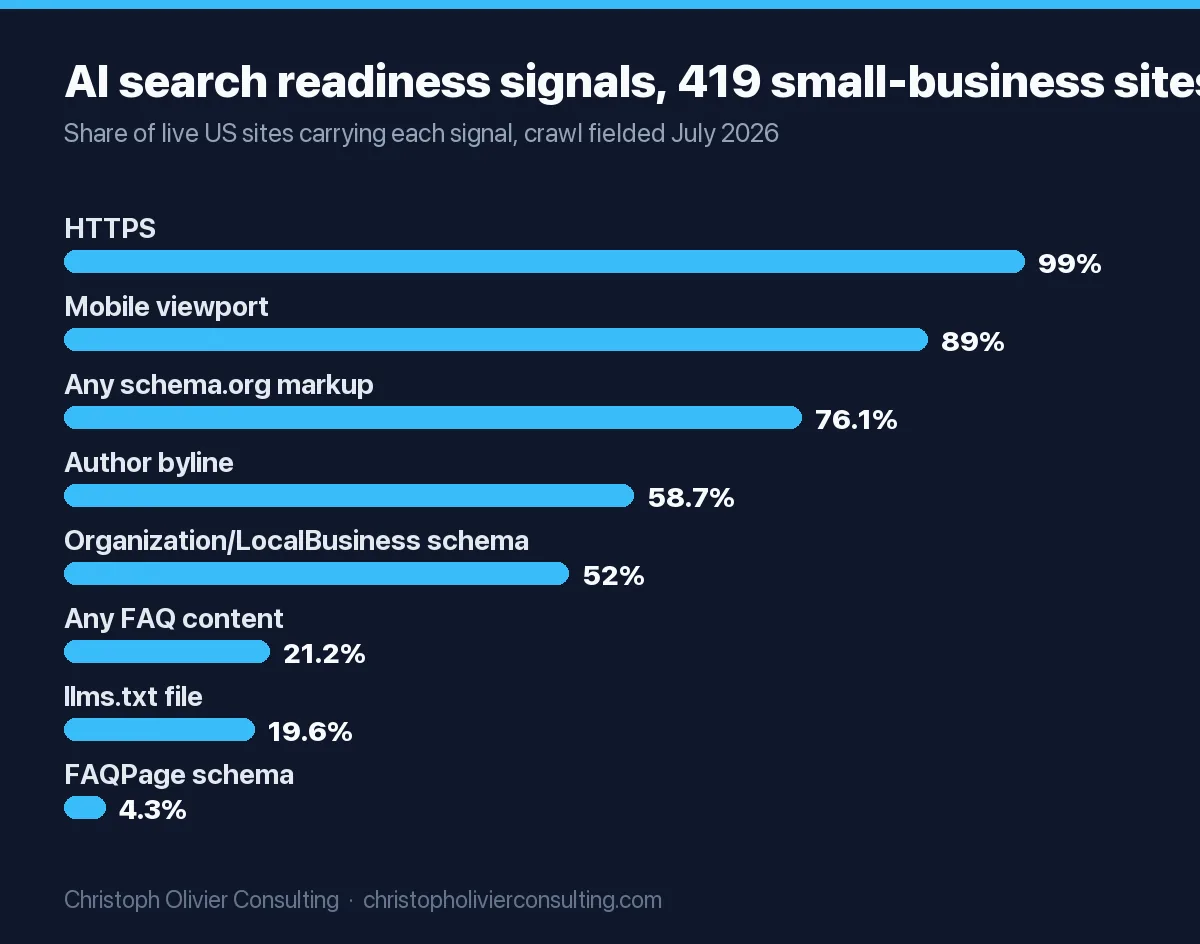
The headline results:
- 22.4% of live sites (94 of 419) were AI-invisible by the study’s definition: no schema.org structured data, no llms.txt file and no FAQ content.
- The mean AI-Readiness Index was 59.7 out of 100.
- Basic hygiene was near universal (HTTPS 99.0%) while FAQPage schema reached only 4.3%.
- 91.2% of sites stated no policy on OpenAI’s GPTBot in robots.txt.
- Dental and medical practices led at 63.3; financial advisors and RIAs trailed at 56.4.
Signal adoption across the 419 live sites
| Signal | Category | Share of 419 live sites | Site count |
|---|---|---|---|
| HTTPS | Web hygiene | 99.0% | 415 |
| Mobile viewport | Web hygiene | 89.0% | 373 |
| Any schema.org structured data | Structured data | 76.1% | 319 |
| Meta description | Web hygiene | 75.7% | 317 |
| Author or E-E-A-T byline | Trust signal | 58.7% | 246 |
| Organization or LocalBusiness schema | Structured data | 52.0% | 218 |
| Any FAQ content (FAQPage schema or question-style headings) | Answer signal | 21.2% | 89 |
| llms.txt file present | Answer signal | 19.6% | 82 |
| FAQPage schema | Answer signal | 4.3% | 18 |
Site counts are the reported share applied to 419 live sites, rounded to whole sites. Source: Christoph Olivier Consulting, AI Search Readiness Study, fielded July 2026.
Readiness by vertical
Sample sizes run from 62 to 79 sites per vertical, so gaps of two or three points are directional, not decisive. Law and accounting tie at 57.1.
| Rank | Vertical | Mean AI-Readiness Index | AI-invisible | Any schema | n |
|---|---|---|---|---|---|
| 1 | Dental and medical | 63.3 | 13.9% | 84.8% | 79 |
| 2 | Marketing agencies | 63.2 | 27.4% | 71.2% | 73 |
| 3 | Home services (HVAC, plumbing, roofing) | 60.4 | 21.0% | 79.0% | 62 |
| 4 (tie) | Law and estate planning | 57.1 | 26.9% | 71.6% | 67 |
| 4 (tie) | Accounting and CPA | 57.1 | 24.6% | 72.3% | 65 |
| 6 | Financial advisors and RIAs | 56.4 | 21.9% | 76.7% | 73 |
Marketing agencies show a split field: the second-highest mean score, 63.2, and the highest AI-invisible share, 27.4%. Strong agency sites pull the average up while about one in four fail all three core signals. The six vertical sample sizes sum to 419, and the vertical averages weighted by sample size reproduce the overall 59.7.
Stated AI crawler policy in robots.txt
| Crawler or token | Operator | Not mentioned | Blocked | Explicitly allowed |
|---|---|---|---|---|
| GPTBot | OpenAI | 91.2% | 3.1% | 5.7% |
| Google-Extended | 90.2% | 3.1% | 6.7% | |
| ClaudeBot | Anthropic | 91.2% | 3.1% | 5.7% |
| OAI-SearchBot | OpenAI | 97.9% | 0% | 2.1% |
| PerplexityBot | Perplexity | 98.8% | 0% | 1.2% |
| CCBot, Bytespider, Applebot-Extended | Common Crawl, ByteDance, Apple | about 91% | about 3 to 4% | about 5% |
robots.txt records stated policy, not enforcement. Source: Christoph Olivier Consulting, AI Search Readiness Study, fielded July 2026.
The finding is silence, not direction. For every named crawler, more than 90% of sites take no stated position, and in no case does blocking exceed explicit allowing. No site in the sample blocked the two search crawlers, OAI-SearchBot and PerplexityBot. For comparison, Cloudflare found that of 3,816 domains from the top 10,000 that had a robots.txt file, 546 (about 14%) had allow or disallow rules aimed at AI bots, and GPTBot requests rose 305% from May 2024 to May 2025. A stated AI policy is uncommon even among large sites.
Structured data types found
Across the 319 sites with any schema.org markup, identity and site-structure types dominate. Counts are the number of sites on which each type appeared.
| Schema type | Sites using it | What it describes |
|---|---|---|
| Organization | 191 | Identity |
| BreadcrumbList | 179 | Site structure |
| LocalBusiness | 67 | Local identity |
| Person | 51 | Author |
| Service | 28 | Offering |
| Article | 24 | Content |
| FAQPage | 18 | Questions and answers |
| Review | 11 | Reputation |
| Product | 3 | Offering |
| BlogPosting | 2 | Content |
Source: Christoph Olivier Consulting, AI Search Readiness Study, fielded July 2026.
Read this before you quote the index
The AI-Readiness Index is the study’s own rubric. It measures whether a site carries signals we chose to score. It does not measure whether AI systems actually cite the site, and some of its signals carry more weight in the rubric than the platforms themselves give them.
| Signal in the index | Points | What the platforms say |
|---|---|---|
| Any schema.org structured data | 15 | Google: “Structured data isn’t required for generative AI search, and there’s no special schema.org markup you need to add,” though it still recommends structured data as part of overall SEO (Google AI optimization guide) |
| llms.txt file present | 15 | Google Search ignores these files. SE Ranking found no correlation with AI citations (details below). |
| FAQ content: FAQPage schema (15) or question-style headings (7) | up to 15 | No platform requires it; question-and-answer text is simply easy to quote |
| AI crawler openness (reduced if major AI search bots are blocked) | 15 | OpenAI: sites opted out of OAI-SearchBot are not shown in ChatGPT search answers. Perplexity recommends allowing PerplexityBot. |
| Organization or LocalBusiness schema | 10 | Identity markup; see the Google note above |
| Author or E-E-A-T byline | 10 | Trust signal for readers and reviewers |
| HTTPS | 8 | Basic hygiene |
| Mobile viewport | 6 | Basic hygiene |
| Meta description | 6 | Basic hygiene |
Because llms.txt is one of the three “AI-invisible” tests and is worth 15 points, a site that skipped llms.txt on purpose scores lower here without being less visible in Google. Read the 22.4% as “missing all three of the study’s chosen signals,” not as “cannot appear in AI answers.”
Five more limits shape the data:
- Stated policy, not enforcement. Firewall and CDN blocks do not show up in robots.txt, so a site can block AI bots without the study seeing it.
- Two pages per site. Schema that lives only on deeper pages is undercounted.
- No JavaScript. Schema injected by JavaScript or a tag manager is missed, so real schema adoption is somewhat higher than reported and the answer-signal gap somewhat narrower.
- One snapshot. The data is a single July 2026 crawl, not a trend.
- Sampling frame. Sites came from public best-of lists and local directories, independent firms only, with national chains, franchises and directories excluded. That frame may lean more marketing-savvy than the long tail of small firms.
AI search readiness checklist: 15 pass/fail tests
Each test below has a pass condition you can check in minutes, the vendor documentation behind it, and, where the study measured the same signal, the share of the 419 sites that had it. Run it on your homepage and your three most important service pages. Replace example.com with your domain.
| # | Test | How to check | Pass if | Study benchmark |
|---|---|---|---|---|
| 1 | robots.txt is readable | Open example.com/robots.txt | Returns plain text (or a 404, which means no rules); not an error page or a login wall | n/a |
| 2 | OAI-SearchBot is not disallowed | Read the OAI-SearchBot group and the * group | No Disallow covers your public pages. OpenAI: “Sites that are opted out of OAI-SearchBot will not be shown in ChatGPT search answers.” Changes take about 24 hours. | 0% blocked |
| 3 | PerplexityBot is not disallowed | Same check for PerplexityBot | Not disallowed. Perplexity recommends allowing it so your site appears in Perplexity search results; changes can take up to 24 hours | 0% blocked |
| 4 | Googlebot can crawl your key pages | URL Inspection in Search Console | “Crawl allowed” and the page is indexed. Google’s AI features draw on publicly accessible, crawlable content; there is no separate AI crawler to allow | n/a |
| 5 | GPTBot policy is a deliberate decision | Look for a GPTBot group | You chose allow or block on purpose. GPTBot collects content that may be used for model training; blocking it does not opt you out of ChatGPT search, which uses OAI-SearchBot | 91.2% silent |
| 6 | Google-Extended policy is a deliberate decision | Look for a Google-Extended group | You chose on purpose. Google: Google-Extended “does not impact a site’s inclusion in Google Search nor is it used as a ranking signal” | 90.2% silent |
| 7 | Anthropic crawlers are set on purpose | Look for ClaudeBot and Claude-SearchBot groups | ClaudeBot (training) is your choice; Claude-SearchBot is not blocked. Anthropic says disabling Claude-SearchBot prevents indexing for search and may reduce visibility | ClaudeBot 91.2% silent |
| 8 | Your firewall does not challenge AI search bots | Run the curl test below | HTTP 200 with real page content, not 403, 429 or a challenge page | Not measurable by the study |
| 9 | Key content is in the raw HTML | View source, or curl the page and search for a sentence from the body | Main text and any JSON-LD appear without running JavaScript | Study fetched without JavaScript |
| 10 | Identity markup validates | Paste the homepage into validator.schema.org | Organization or LocalBusiness JSON-LD with your legal name, address and phone, zero errors | 52.0% |
| 11 | Articles show a named author | Open three articles | Each shows a real person’s name linked to a bio | 58.7% |
| 12 | Service pages answer client questions in plain text | List the three questions prospects ask most, then search the page for each | Each question has a heading in the client’s words and a direct answer under it | 21.2% had any FAQ content |
| 13 | Search Console AI setting is what you intend | Search Console, Settings, Search generative AI | Set to include (the default) unless you chose to opt out. Google: this control covers AI Overviews, AI Mode and Discover’s generative AI features, and does not control training | n/a |
| 14 | AI traffic is reported monthly | GA4 Traffic acquisition report | You can see an AI Assistant channel (or a custom AI channel) and a monthly number | n/a |
| 15 | HTTPS and mobile viewport | Load the site on a phone | Padlock shown, page fits the screen | 99.0% and 89.0% |
What about llms.txt? It is not on the pass/fail list, because nothing documented depends on it. llms.txt is a proposal by Jeremy Howard dated September 3, 2024, not a ratified standard. Google’s AI optimization guide says you do not need it and that Google Search ignores these files. SE Ranking analyzed about 300,000 domains, found 10.13% had the file, and found no correlation with AI citations; its model got more accurate when the llms.txt variable was removed. The study sample’s 19.6% is higher than SE Ranking’s 10.13%, but the two samples differ in size and makeup. Our SEO terms glossary keeps the current status of llms.txt, Google-Extended and the Search generative AI control in one place. Add the file if another AI provider you care about documents a use for it; otherwise it is optional.
Copy-ready robots.txt for AI search readiness
This template allows the search crawlers and opts out of model training. The training lines are a business choice, not a requirement: delete them if you are happy for your content to be used in training.
# AI search and answer crawlers: allow
User-agent: OAI-SearchBot
Allow: /

User-agent: PerplexityBot
Allow: /

User-agent: Claude-SearchBot
Allow: /

# Model training: your decision (this example opts out)
User-agent: GPTBot
Disallow: /

User-agent: Google-Extended
Disallow: /

User-agent: ClaudeBot
Disallow: /

# Everyone else, including Googlebot
User-agent: *
Allow: /

Sitemap: https://www.example.com/sitemap.xml
Two notes from the vendors’ documentation. User-initiated fetchers behave differently: Perplexity says Perplexity-User generally ignores robots.txt because a person asked for the page, and OpenAI says robots.txt rules may not apply to ChatGPT-User. And because Google-Extended has no user agent of its own, blocking it changes how Google may use your content in Gemini, not whether Googlebot crawls you.
The firewall and raw HTML tests
# Test 8: does your firewall let a PerplexityBot request through?
curl -s -o /dev/null -w "%{http_code}\n" \
  -A "Mozilla/5.0 (compatible; PerplexityBot/1.0; +https://perplexity.ai/perplexitybot)" \
  https://www.example.com/

# Same test with the OpenAI search crawler's token
curl -s -o /dev/null -w "%{http_code}\n" -A "OAI-SearchBot/1.4" https://www.example.com/

# Test 9: is your JSON-LD in the raw HTML?
curl -s https://www.example.com/services/ | grep -c "application/ld+json"
A 200 passes. A 403 or a challenge page means a firewall rule is matching the user agent. The test is not perfect: a faked user agent only checks rules keyed on the name. Real crawlers are verified by IP address, and both vendors publish their ranges (openai.com/searchbot.json and perplexity.ai/perplexitybot.json), so if your firewall allow-lists by IP, check that those ranges are in it. For test 9, a result of 0 means either no JSON-LD or JSON-LD injected by JavaScript, which is exactly what the study could not see.
AI search readiness roadmap: fix in this order
The order matters because each step depends on the one before it. Markup cannot help a page a crawler cannot fetch.
- Access (day 1). Tests 1 to 8. A single Disallow or firewall rule can remove you from ChatGPT or Perplexity search entirely, and robots.txt changes take up to about 24 hours to register with both vendors.
- Measurement (day 1 to 2). Test 14 and the GA4 steps below. Record a baseline before you change content, or you will not know what moved.
- Decisions (week 1). Tests 5, 6, 7 and 13. Write down your training policy and your Search Console AI setting so the next web developer does not undo them.
- Machine-readable basics (weeks 2 to 3). Tests 9 to 11. Server-rendered content, valid identity markup, named authors.
- Answer content (weeks 3 to 6). Test 12 on every service page, starting with the pages that already get impressions in Search Console. The answer engine optimization guide covers how each engine retrieves and cites pages.
- Review (monthly). Compare AI sessions, the Search Console Generative AI performance report and your citations against the baseline.
How to measure AI referral traffic in GA4
GA4 now does most of this for you. On May 13, 2026, Google added an AI Assistant channel to the Default Channel Group, and on June 11, 2026 it added a Source Group field that groups sources such as ChatGPT and Perplexity (GA4 release notes).
- Find the channel. Reports, Acquisition, Traffic acquisition, with the primary dimension set to Session default channel group. Look for AI Assistant. Per Google’s channel definitions, it matches medium “ai-assistant” or a referrer on Google’s list of AI assistants, with ChatGPT, Gemini, DeepSeek, Copilot and Grok as named examples.
- Know what it excludes. Google’s AI Overviews and AI Mode are not in the AI Assistant channel. Clicks from them land in Organic Search. For those, use the Generative AI performance report in Search Console, which Google’s AI optimization guide points to for Search and Discover.
- Check for gaps. Switch the dimension to Session source and search for chatgpt.com, perplexity.ai, gemini.google.com, copilot.microsoft.com and claude.ai. Any of these still showing under Referral is a source the default list is not catching.
- Build a custom channel group if you find gaps. Admin, Data display, Channel groups, Create new channel group. Add a channel named “AI search” with the condition Source matches regex
.*(chatgpt\.com|openai\.com|perplexity\.ai|gemini\.google\.com|copilot\.microsoft\.com|claude\.ai).*, click Reorder, and drag it above Referral. Traffic goes to the first channel it matches, which is why the order matters (GA4 channel groups help). Standard properties allow 2 custom groups with up to 50 channels each, and custom groups can be applied to reports retroactively. - Report one number monthly. AI sessions, and the conversions those sessions produced, next to organic search.
Worked example. Suppose GA4 shows 6,000 sessions a month from search, social and AI referrals combined. At StatCounter’s September 2026 mix of 0.40% for AI chatbots, the benchmark would be about 24 AI sessions (6,000 × 0.004). If you see 0, check tests 2, 3 and 8 first. If you see 120, AI already sends you five times the benchmark share and is worth reporting on its own line. StatCounter measures referral share across its own site network, so treat this as a sense check, not a target. The full setup, including Search Console filters, is in our guide to tracking AI search traffic in GA4 and GSC. If you would rather have someone run the checklist and the GA4 setup with you, you can book a consultation.
How to cite the AI Search Readiness Study
Copy-ready citation: Christoph Olivier Consulting, AI Search Readiness Study 2026. Crawl of 487 US small-business and professional-services websites (419 live) across six verticals and ten cities, fielded July 2026, published July 25, 2026. https://christopholivierconsulting.com/ai-search-readiness-study-2026/
Accurate one-line versions:
- 22.4% of 419 live US small-business websites had no schema.org markup, no llms.txt file and no FAQ content (AI Search Readiness Study, July 2026).
- Only 4.3% of the sites used FAQPage schema, against 99.0% using HTTPS.
- 91.2% stated no policy on OpenAI’s GPTBot in robots.txt, and none blocked OAI-SearchBot or PerplexityBot.
- Dental and medical practices scored highest at 63.3 out of 100; financial advisors and RIAs lowest at 56.4.
Please do not describe the 22.4% as sites that “cannot be found by AI.” The test is whether a site carries the study’s three chosen signals, one of which (llms.txt) Google says it ignores.
Frequently asked questions
What is AI search readiness?
AI search readiness is how easily AI search tools such as ChatGPT search, Perplexity and Google AI Overviews can fetch, read and cite your website. In practice it comes down to crawler access in robots.txt and your firewall, content that appears in raw HTML, clear identity information, plain-text answers to client questions, and analytics that show what AI search actually sends you.
What are the key AI search adoption statistics for 2025-2026?
Pew found 49% of US adults used AI chatbots in February 2026 and 42% use them to search for information. Google reported over 2.5 billion monthly AI Overviews users in May 2026. Pew measured 8% clicks on traditional results with an AI summary versus 15% without (March 2025). StatCounter shows AI chatbots sent 0.40% of referral visits in September 2026.
What did the AI search readiness study find?
The study crawled 487 US small-business and professional-services websites in July 2026, of which 419 were live. 22.4% had no schema.org markup, no llms.txt file and no FAQ content. The mean AI-Readiness Index was 59.7 out of 100, only 4.3% used FAQPage schema, and 91.2% stated no GPTBot policy in robots.txt.
When was the AI Search Readiness Study conducted and published?
The crawl was fielded in July 2026 and the findings were published on July 25, 2026. It is a single snapshot, not a time series. The external adoption statistics that sit around the study were rechecked on November 1, 2026, but the study's own figures have not been changed since publication.
Does blocking GPTBot remove my site from ChatGPT search?
No. OpenAI documents GPTBot as the crawler for content that may be used to train its models, while OAI-SearchBot surfaces sites in ChatGPT search. Sites that opt out of OAI-SearchBot are not shown in ChatGPT search answers. You can block GPTBot and allow OAI-SearchBot. OpenAI says robots.txt changes take about 24 hours to apply.
Do I need an llms.txt file to be ready for AI search?
No. llms.txt is a September 2024 proposal, not a ratified standard. Google says Google Search ignores these files and you do not need them. SE Ranking analyzed about 300,000 domains and found no correlation between having llms.txt and AI citations. Add one only if an AI provider you care about documents a use for it.
How do I track AI search referral traffic in GA4?
Open Traffic acquisition and look for the AI Assistant channel Google added to the Default Channel Group on May 13, 2026. It excludes AI Overviews and AI Mode, which count as Organic Search, so use the Search Console Generative AI performance report for those. If AI sources still show as Referral, build a custom channel group above Referral.
More original research from CO Consulting
- Small Business Website Speed: A 320-Site Performance Study (2026)
- US Advertising and Marketing Industry Statistics 2026: Revenue, Employment, and Wages
- Consumer Trust in Advertising and Marketing Statistics for 2026
- 27 Local SEO and Google Business Profile Statistics and Data Points for 2026
- 52 SEO Statistics and Data Points for 2026: Search Share, Zero-Click, and the AI Overviews Shift
- Podcast and Audio Advertising Statistics for 2026: 27 Verified Data Points
- 27 Connected TV and Streaming Advertising Statistics for 2026
- 31 Online Reviews and Reputation Statistics for 2026
More Marketing Research guides